
By Ibel Perez, owner of Super Diver 911
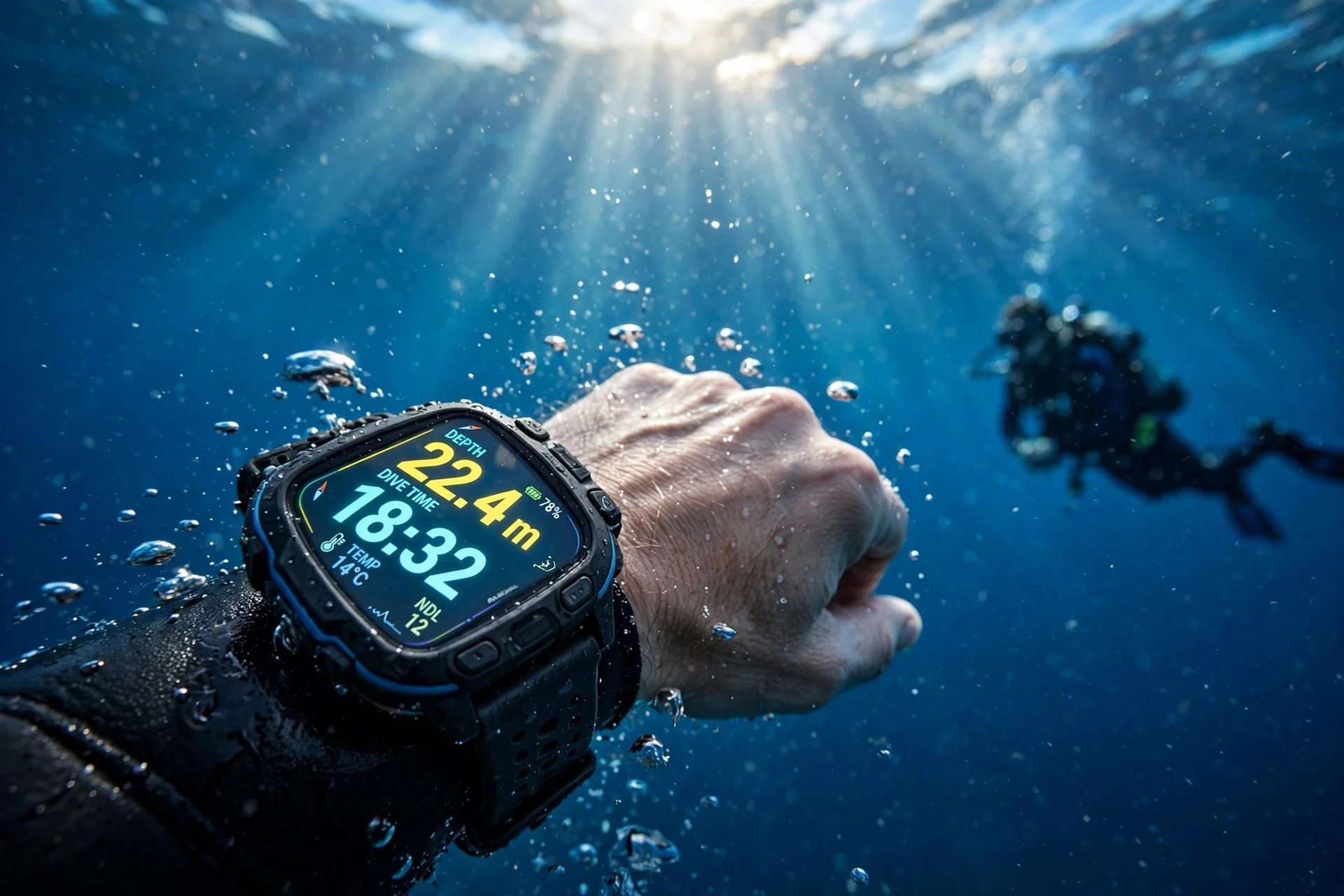
The big dive show, DEMA, just wrapped up in New Orleans (Nov 3–6), and the new dive computers were the talk of the floor. These are the five new models divers are searching for most right now.
We judged them the way a diver should: first by the screen. How bright is it? How do the colors hold up under water? Then by battery, features, and price. Prices below are U.S. list prices, checked November 14, 2026.
And we count down — from number five to number one. The best one is saved for last.
Why brightness and color matter so much under water
Water eats color. Red is gone by about 15 feet. Orange and yellow fade next. Down deep, everything turns blue and green.
So a screen that looks great in the store can look flat at 80 feet. What saves you is contrast — dark numbers on a bright screen, or bright numbers on a dark screen — and color used as a warning code. Green means fine. Yellow means pay attention. Red means act now. You want to read that in one glance, through a mask, in green water, with gloves on.
Three kinds of screens show up in this list. AMOLED is the bright, rich color screen, like a good phone. It uses more battery. MIP is a black-and-white screen that reflects light back at you; it is easy to read in sun and murk and sips power. A basic backlit LCD is the cheapest and the dimmest of the three.
5.SCUBAPRO Aladin 100 — $299
Unveiled at DEMA and built to be simple. A 2.4-inch black-and-white screen with big fields for depth, time, and no-stop time.
Pros:
The lowest price here, from one of the oldest names in diving.
The battery is a plain AA you change yourself, and it lasts more than 300 hours — years of diving between swaps.
Two buttons, plain menus, and a bungee strap that adjusts with one hand. Nothing to learn.
Cons:
The lowest-resolution screen on this list, and no color. It is clear, but it is basic.
One gas only (nitrox up to 50%), no air integration, and an 80-meter limit.
If you plan to grow into technical diving, you will outgrow it.
4.Garmin Descent X10 — $349.99
Garmin’s brand-new budget computer, launched November 3. No color at all — and that is its trick.
The screen is a 2.1-inch black-and-white MIP display with a backlight. It reflects light instead of fighting it.
Pros:
Very high contrast with huge numbers. In bright sun or green murk, it is one of the easiest screens here to read.
Up to 50 hours of dive time on one charge, and months on standby.
Runs the same proven Bühlmann decompression math as Garmin’s expensive flagships, and its NDL Aware feature shows how going deeper or shallower changes your no-stop time, live.
A rental mode makes it a favorite for dive schools — and a smart first computer.
Cons:
No color. Warnings cannot be color-coded; you read numbers and alarms instead.
One gas only, nitrox up to 40%. No trimix, no rebreather.
No air integration and no GPS.
Shopping for the rest of your kit?
A computer only tells you the numbers — your regulator does the breathing. See the NEX regulators, BCDs, masks, and fins we dive ourselves: Shop gear at Super Diver 911
3.Suunto Nautic S — $549
The Nautic’s little brother: the same new Suunto brain in a normal watch size, with a 1.43-inch AMOLED screen under sapphire glass.
Pros:
Bright, rich color in a watch you can wear every day.
Up to five gases and support for two tank transmitters, so even sidemount divers are covered.
40 to 60 hours of dive time per charge, plus GPS and offline maps.
Cons:
Small screen means smaller numbers. Bright, yes — big, no.
Rated to 80 meters. Fine for recreational diving, but technical divers should keep reading — numbers two and one are built for that.
Tank transmitter is extra.
2.Suunto Nautic — $699
Suunto’s new big-screen computer, and “big” is the word. The screen is 3.26 inches — the largest on any dive computer.
Pros:
Huge, bright AMOLED color screen. If your eyes are not what they used to be, this is your computer.
Battery life is the best of the color screens here: up to about 120 hours of diving on a charge.
Up to five gases, wireless tank pressure (transmitter sold separately), GPS and maps on the surface, and even a built-in flashlight.
Cons:
It is a lot of computer: big and heavy on the wrist at about 227 grams.
More features than a new diver needs, and the price climbs once you add the tank transmitter.
1.Shearwater Perdix 3 — $1,295
The new flagship from Shearwater, the brand technical divers trust most — and our number one.
The screen: a 2.4-inch AMOLED with about four times the sharpness of the old Perdix 2, plus a new "Big" layout with oversized numbers.
Pros:
The sharpest, brightest color screen in its class. Warnings are color-coded and pop, even in dark water.
Does it all: air, nitrox, trimix, and rebreather (CCR) modes, so it grows with you from first dive to technical diving.
Reads up to four tank transmitters at once (transmitters sold separately).
Runs on one AA battery you can buy anywhere — up to 60 hours on a lithium AA.
Cons:
The most expensive computer on this list, and the transmitters cost extra.
That bright screen drinks power faster than a plain screen. The AA swap makes it painless, but you do have to swap.
Big on the wrist. It is a tool, not a fashion watch.
Side by side: brightness, color, comfort, trimix, price, and reliability
Brightness and color. The Perdix 3 has the sharpest bright color screen (2.4-inch AMOLED). The Nautic has the biggest color screen (3.26-inch AMOLED) — the easiest to read at a glance. The Nautic S is just as bright and colorful, only smaller (1.43-inch AMOLED). The Descent X10 and the Aladin 100 have no color at all: the X10's black-and-white screen has stronger contrast, while the Aladin 100's basic backlit screen is the plainest of the five.
Comfort. The Nautic S wins — a light watch (81 grams) you forget you are wearing. The X10 is also watch-sized and easy all day. The Aladin 100 is light, and its bungee strap slips on fast over a wetsuit sleeve. The Perdix 3 is a bigger unit built for serious diving. The Nautic is the heavyweight at about 227 grams — you feel it on your wrist, and the giant screen is why.
Trimix or not. Trimix means a breathing gas with helium added, used for deep technical dives. The Perdix 3: yes, full trimix and rebreather support. The Nautic: yes, up to five gases including trimix. The Nautic S: multi-gas, up to five gases, for advanced diving. The Descent X10: no — one gas only. The Aladin 100: no — one gas only.
Price. Perdix 3: $1,295. Nautic: $699. Nautic S: $549. Descent X10: $349.99. Aladin 100: $299.
Reliability. Honest point first: all five are new, so nobody has years of dives on them yet. What we can judge is the maker's record. Shearwater (Perdix 3) is the reliability name technical divers trust with their lives, it is rated to 260 meters, and its AA battery removes the most common failure of all — a dead battery you cannot change. Suunto has built dive instruments for decades; the Nautic S adds sapphire glass, though both Suuntos use sealed rechargeable batteries that slowly age over the years. Garmin (Descent X10) has the biggest support network in the world and its screen type is proven across millions of watches, but this is a first-generation budget dive model. SCUBAPRO's Aladin line has run for decades, and the 100 is so simple there is little to break — it was built for rental fleets, and rental gear takes a beating.
So which one should you buy?
Want the brightest, sharpest screen and room to grow into technical diving? Perdix 3.
Want the biggest screen and the longest battery? Suunto Nautic.
Want color in a normal watch? Nautic S.
Want the best value and a screen that never quits? Garmin Descent X10.
Want the cheapest, simplest computer that just works? Aladin 100.
One honest note: Super Diver 911 does not sell dive computers. We sell NEX regulators and dive gear, and we service regulators. This guide exists for one reason — to help you choose right. When you are ready for the regulator that goes with your new computer, read our guide: What Scuba Gear Do You Need? A New Diver's Guide by Where You Dive
Not ready to buy yet? Join free for gear tips and the monthly special: superdiver911.com/membership
Questions about any of this gear? Call or text us at (754) 444-2431, or visit superdiver911.com. We are a family-owned dive shop, and a real diver answers.
Support the little guy — shop with a family-owned dive shop.
Super Diver 911 is a small, family-owned dive shop. When you buy from us instead of a big-box store, you keep real dive shops alive — the shops that train divers, service gear, and keep this sport personal. Visit our website, browse the gear, and reach out any time: we match and beat any authorized dealer's discount, and shipping is free anywhere in the U.S.
Let's help the little guy — support the family-owned dive shops. They're the heart of this sport.
