
By Ibel Perez, owner of Super Diver 911
Sooner or later, every diver who picks up a NEX second stage hears it from a buddy: "It's plastic. How good can it be?"
It's a fair question — and it gets the engineering exactly backwards. Here's what's actually inside a NEX second stage, why the housing is made the way it is, and how the 2.5 and 2.0 models really differ, so you can choose the one that fits your diving.
What’s Inside a Second Stage (and What’s Metal)
A second stage has one job: take the intermediate-pressure air from your first stage and deliver it to you, on demand, at ambient pressure. The parts that do that metering — the demand valve assembly, the lever mechanism, the seat and the fittings that have to hold pressure and move precisely, breath after breath — are metal, precision-machined components. That's true of NEX, and it's true of every serious regulator on the market.
The housing has a different job: protect that mechanism, hold the diaphragm, route your exhaust bubbles away, and survive being knocked around on boats and rinsed in tubs for years. For that job, metal is not an upgrade — it's a compromise:
Salt water attacks metal. Chrome-plated brass housings can pit and flake over years of salt exposure. An advanced polymer housing simply cannot corrode.
Metal is heavy where you feel it most. A second stage hangs from your mouth for an hour at a time. Every gram saved is jaw fatigue you don't get.
Polymer shrugs off bumps. Boat decks, tank valves, rinse tanks — a composite housing takes the knocks of real diving without denting.
NEX lists its second stages at 0.2 lbs. That lightness isn't the absence of quality. It's the point.
And here's the part nobody mentions at the dive shop counter: pick up the flagship second stages from the big legacy brands and you'll find advanced composite housings there too. The industry figured this out a long time ago. Metal where it meters air, polymer where metal only adds weight, cost, and corrosion — that's not a shortcut. That's the design.
The NEX Difference: A Housing You Can Replace and Make Yours
Because the housing is a shell around the mechanism, NEX treats it like one. Every NEX second stage offers:
Customizable housing and purge-button colors — your regulator doesn't have to look like everyone else's rental-era black box.
A replaceable housing — scuff it, crack it, or just get tired of the color, and the housing can be replaced instead of buying a whole new second stage.
A 2-year warranty, assembly in the United States, and — at Super Diver 911 — a 24-hour pressure test before any regulator ships, so the regulator that reaches you has already been proven.
2.5 vs 2.0: The Numbers Are Inches
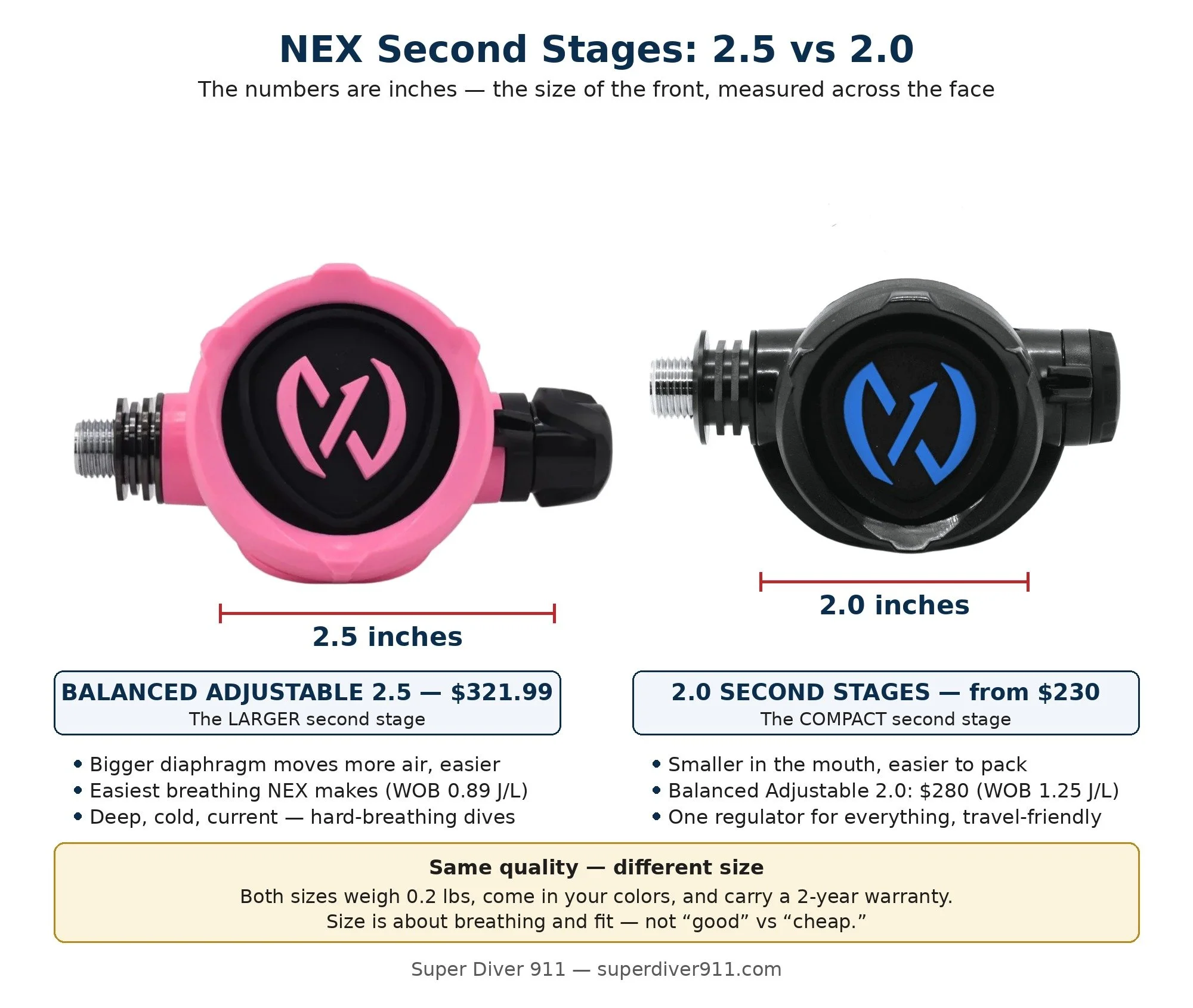
The model numbers are literal: the 2.5 and the 2.0 are the sizes of the second stage. The 2.5 is the bigger unit, with a larger diaphragm; the 2.0 is the compact version. Both sizes are balanced, both give you an adjustment knob to fine-tune inhalation effort, and both have Venturi control to manage airflow and discourage free-flows at the surface.
Where they separate is breathing effort. Regulators are measured by Work of Breathing (WOB) — how much effort each breath takes, in joules per liter. Lower is easier:
Balanced Adjustable 2.5 — $321.99. WOB 0.89 J/L. The flagship. That larger diaphragm moves more air with less effort, and you feel it most on deep dives, in current, or any time you're breathing hard. If you want the easiest-breathing second stage NEX makes, this is it.
Balanced Adjustable 2.0 — $280.00. WOB 1.25 J/L. The compact all-rounder — and not a compromise pick. This is the second stage fitted to the N1 Stealth Tester's Choice Bundle ($980), the regulator set that earned ScubaLab's Testers Choice for regulators over $700. Smaller in the mouth, easier to pack, proven at the top level.
Shopping for the gear in this guide?
See the exact gear this post talks about in our shop — family-owned, free U.S. shipping, and we match and beat any authorized dealer's discount.
👉 Shop the gear at superdiver911.com
The Rest of the Family
Balanced 2.0 — from $255. Same balanced design and 1.25 J/L breathing, without the adjustment knob. One less control, nothing to fiddle with — set-and-forget divers and a lot of octopus setups live here. (Also available in the 2.5 size.)
Unbalanced 2.0 — from $230. The classic, straightforward downstream design. Fewer refinements, utterly dependable, and the friendliest price in the line — a favorite for backup/octopus duty and first-regulator budgets. (Also available in the 2.5 size.)
NEX vs. the Legacy Brands: The Honest Ledger
Where NEX wins: breathing performance per dollar (compare second-stage prices across brands before you decide the polymer is the "cheap" part), customization no legacy brand offers at any price, a replaceable housing instead of a replaceable regulator, U.S. assembly, and a modern design that isn't carrying forty years of legacy tooling decisions.
Where the legacy brands win: sheer history. They have larger walk-in dealer networks built over decades, and if you specifically want a metal housing for its own sake, they'll sell you one — at metal-housing prices and metal-housing weight. What they won't give you is better air metering, because that was never about the housing.
And the service question has an answer either way: have your regulator serviced every 100 dives or every 2 years, whichever comes first. Super Diver 911's mail-in regulator service turns most services around in 3 to 7 business days.
So Which One Is Yours?
Deep, cold, current, long bottom times, or you simply want the best breather: the Balanced Adjustable 2.5.
One regulator for everything, travel-friendly, award-tested pedigree: the Balanced Adjustable 2.0.
Simple, balanced, no knob to think about: the Balanced 2.0.
A dependable octopus or a first regulator on a budget: the Unbalanced 2.0.
Not ready to buy yet? Join free for gear tips and the monthly special: superdiver911.com/membership
Still torn? That's what we're here for — call or text (754) 444-2431 and tell us how you dive, and we'll steer you to the right one, even if it's the cheaper one. And for the bigger picture on building a full regulator set, read our NEX Regulator Buying Guide.
Plastic housing. Metal heart. Lighter in your mouth, easier on your jaw, and built to be serviced instead of replaced. Visit superdiver911.com to build yours.
Support the little guy — shop with a family-owned dive shop.
Super Diver 911 is a small, family-owned dive shop. When you buy from us instead of a big-box store, you keep real dive shops alive — the shops that train divers, service gear, and keep this sport personal. Visit our website, browse the gear, and reach out any time: we match and beat any authorized dealer's discount, and shipping is free anywhere in the U.S.
Let’s help the little guy — support the family-owned dive shops. They’re the heart of this sport.
