
By Ibel Perez, owner of Super Diver 911
It's one of the first choices you'll make when you buy a regulator, and one of the least explained: DIN or Yoke? The good news is there's no wrong answer — there's only the answer that matches the diving you actually do. Here's how the two connections work, where each one shines, and how to pick.
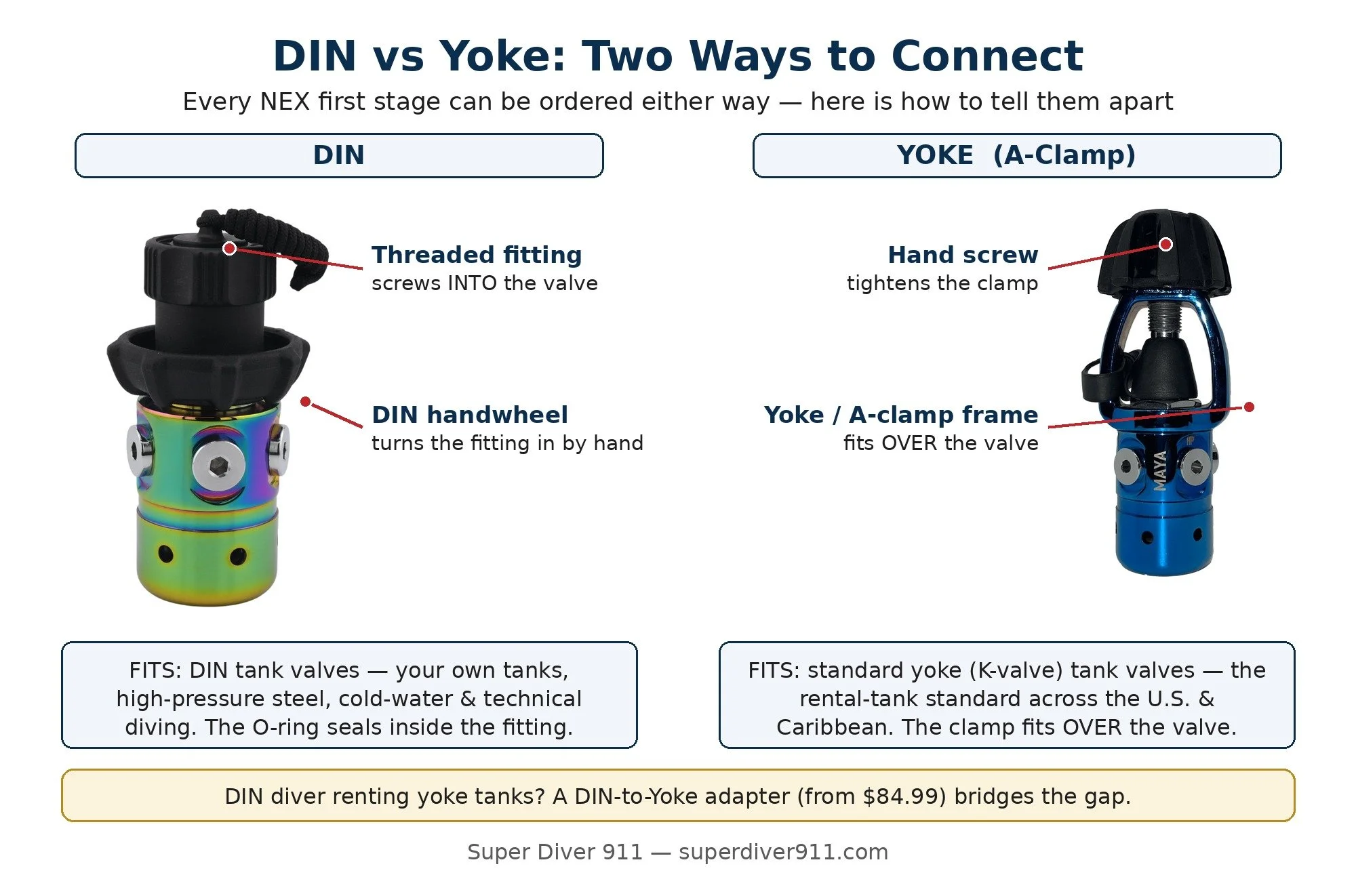
What Is a Yoke Connection?
The Yoke (also called A-clamp or INT) connection is the one most American divers learned on. A metal frame fits over the tank valve, and a hand screw presses the first stage against the valve face. The sealing O-ring sits in a groove on the tank valve itself.
Yoke is the standard on rental tanks across the U.S. and the Caribbean, which is why it's the default for most recreational divers. It's simple, it needs no tools, and any dive shop from Key Largo to Cozumel can hand you a tank that fits.
What Is a DIN Connection?
DIN works differently. The first stage screws directly into the tank valve, and the O-ring is captured inside the regulator's fitting, where it's protected from damage and can't be blown out by pressure. Because the connection is threaded metal-to-metal, DIN is rated for higher tank pressures and makes a slightly more compact, lower-profile setup behind your head.
DIN is the standard in Europe, and it's the overwhelming choice among technical divers, cold-water divers, and anyone running high-pressure steel tanks.
DIN vs Yoke: The Honest Pros and Cons
Shopping for the gear in this guide?
See the exact gear this post talks about in our shop — family-owned, free U.S. shipping, and we match and beat any authorized dealer's discount.
👉 Shop the gear at superdiver911.com
Reasons to choose DIN
Higher pressure rating. DIN handles higher-pressure cylinders comfortably, which matters if you dive HP steel tanks.
A protected O-ring. The seal lives inside the fitting, not exposed on the valve face, so it's less likely to get nicked, dirty, or extruded.
Compact profile. The connection sits lower and tighter, which streamlines divers appreciate — especially in overhead environments like wrecks and caves.
Cold-water and technical pedigree. If your diving is heading toward tec, doubles, or sidemount, DIN is where you’ll end up anyway.
Reasons to choose Yoke
Rental-tank compatibility. If most of your diving is on vacation with rental gear in the U.S. or Caribbean, Yoke fits nearly every tank you'll be handed.
Dead simple. On, off, no threaded fitting to cross-thread or keep clean of sand.
Everywhere you already dive. For warm-water recreational diving at recreational pressures, Yoke does the job perfectly well.
The catches
DIN's catch is travel: show up at a rental operation with only Yoke tanks and a DIN regulator, and you'll need an adapter (more on that below). Yoke's catch is the exposed valve-face O-ring and its lower pressure ceiling — not a problem at typical recreational pressures, but a real limit with high-pressure tanks.
So Which One Should You Buy?
Mostly local and vacation diving on rental tanks? Yoke, and don’t overthink it.
Buying your own tanks, especially high-pressure steel? DIN.
Cold water, wreck, cave, or technical ambitions? DIN.
A mix of home diving and travel? DIN plus an adapter gives you both worlds — your regulator at home, any rental tank on the road.
One more thing worth knowing: this doesn't have to be a forever decision, and at Super Diver 911 it isn't a stressful one. On our shop page, every NEX first stage lets you choose DIN or Yoke when you order — including the N1 Stealth, the regulator that won ScubaLab's Testers Choice for regulators over $700. Pick the connection that fits your diving today, configured the way you want it, with the color options NEX offers for that model.
What About Adapters?
Adapters are the bridge between the two systems. A DIN-to-Yoke adapter lets a DIN first stage connect to a Yoke valve — the classic travel move for DIN divers renting tanks. Going the other direction generally means a valve or first-stage conversion rather than a simple adapter, which is another reason traveling divers tend to standardize on DIN plus the adapter.
Whichever connection you choose, keep it serviced on schedule — a clean, well-maintained first stage seals better and breathes better, DIN or Yoke. (Our regulator service page covers what that involves.)
The Bottom Line
Yoke is the rental-friendly, keep-it-simple standard. DIN is the higher-pressure, more compact, tec-friendly connection. Match the choice to your tanks and your travel, and you'll never think about it again — which is exactly what a good connection should let you do.
Not ready to buy yet? Join free for gear tips and the monthly special: superdiver911.com/membership
Ready to pick yours? Browse the full line of NEX regulators at superdiver911.com — every first stage can be ordered your way, DIN or Yoke, and ships free anywhere in the U.S. except P.O. boxes and military APO/FPO/DPO addresses. Questions about which setup fits your diving? Reach out — you'll get a straight answer from a diver, not a call center.
Support the little guy — shop with a family-owned dive shop.
Super Diver 911 is a small, family-owned dive shop. When you buy from us instead of a big-box store, you keep real dive shops alive — the shops that train divers, service gear, and keep this sport personal. Visit our website, browse the gear, and reach out any time: we match and beat any authorized dealer's discount, and shipping is free anywhere in the U.S.
Let’s help the little guy — support the family-owned dive shops. They’re the heart of this sport.
